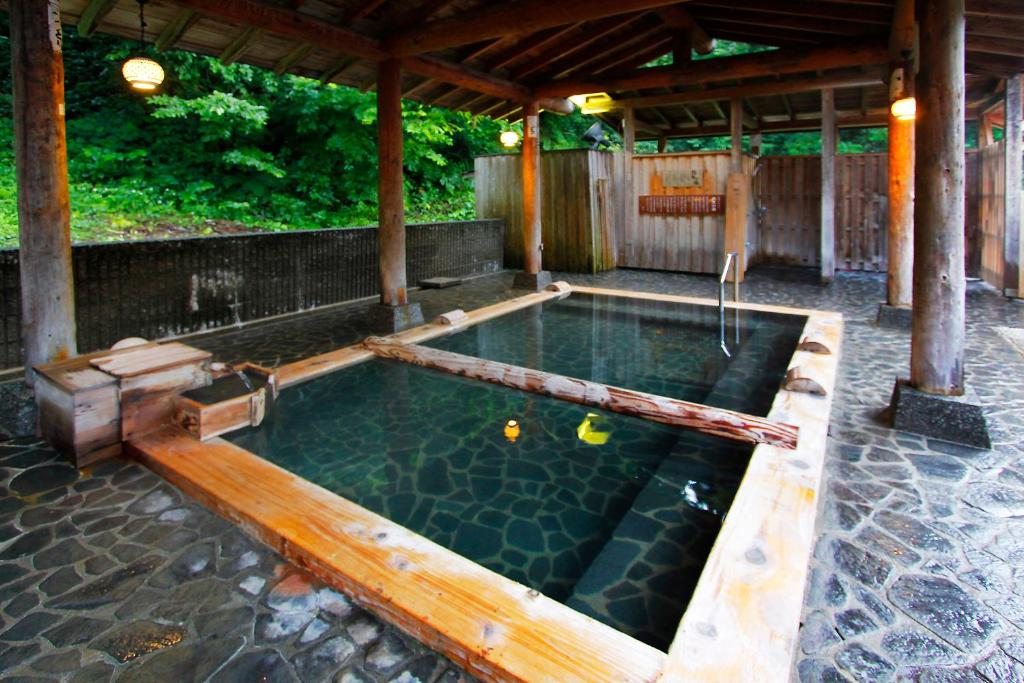
Kaikake Onsen
Analysis UnverifiedThe Kaikake Onsen source is said to have been discovered in the Kamakura period some 700 years ago, and a travel account from 1488 already describes water welling from a rock fissure. Known as a hidden bath of the warlord Uesugi Kenshin and, in the Edo period, as an "eye spring," it was even licensed as eye drops in the Meiji era. Over 400 L/min gushes naturally, and the near-body-temperature water wraps the skin in fine bubbles, letting body and mind unwind over a long, gentle soak.
The bar length shows how abundant each component is compared to thresholds that make it "distinctive" (therapeutic spring standards, beauty spring criteria, etc.).
A trace component with gentle antibacterial and anti-inflammatory action.
Scores are calculated from mineral analysis data based on the Mineral Spring Analysis Guidelines (Ministry of Environment, Japan). They are unrelated to facility atmosphere or service quality.
▸Note
The temperature, pH and component values shown here are based on the hot spring analysis (source). Actual values in the bath may differ depending on heating, dilution, recycling and filtration. Please check current usage status at the facility.
This near-body-temperature water suits long soaks of 30 minutes to an hour. Dry off promptly afterward and keep warm, as the body can cool quickly.
With 1,026 mg/kg of chloride, this 36.2°C water offers restorative warmth even as a tepid soak, and long, unhurried bathing invites deep relaxation, suiting days of tired eyes or nights when you want restful sleep.
Tepid water invites long soaks, so drink water often, and in winter take care not to get chilled after bathing.
※ See the analysis data below for detailed contraindications
ANALYSIS DATAView all analysis fields ▼
Source Info
- Source name
- Kaikake Onsen
- Spring type
- Sodium-Calcium Chloride Hot Spring
- Source temperature
- 36.2℃
- pH
- 7.7
- Flow rate
- 406 L/min
- Flow type
- 自然湧出
- Osmotic pressure
- 低張性
Analysis Document
- Analysis date
- 2012-10-10
- Analyst organization
- 一般財団法人新潟県環境分析センター
- Registration No.
- 新潟県(登)環企第4号
Cations
- Lithium ion Li⁺
- 1.5 mg/kg
- Sodium ion Na⁺
- 407 mg/kg
- Potassium ion K⁺
- 5.2 mg/kg
- Ammonium ion NH₄⁺
- 0.60 mg/kg
- Magnesium ion Mg²⁺
- 0.90 mg/kg
- Calcium ion Ca²⁺
- 329 mg/kg
- Aluminum ion Al³⁺
- 0.00 mg/kg
- Manganese ion Mn²⁺
- 0.00 mg/kg
- Iron(II) ion Fe²⁺
- 0.00 mg/kg
- Zinc ion Zn²⁺
- 0.00 mg/kg
- Lead ion Pb²⁺
- < 0.005 mg/kg
- Strontium ion Sr²⁺
- 0.90 mg/kg
- Barium ion Ba²⁺
- 0.00 mg/kg
- Copper ion Cu²⁺
- 0.00 mg/kg
- Cadmium ion Cd²⁺
- < 0.001 mg/kg
- Total cations
- 0.74 mg/kg
Anions
- Fluoride ion F⁻
- 0.60 mg/kg
- Chloride ion Cl⁻
- 1026 mg/kg
- Hydrogen sulfide ion HS⁻
- 0.00 mg/kg
- Thiosulfate ion S₂O₃²⁻
- 0.00 mg/kg
- Sulfate ion SO₄²⁻
- 141 mg/kg
- Bicarbonate ion HCO₃⁻
- 18.6 mg/kg
- Carbonate ion CO₃²⁻
- 0.00 mg/kg
- Bromide ion Br⁻
- 5.9 mg/kg
- Iodide ion I⁻
- 1.9 mg/kg
- Hydrogen sulfate HSO₄⁻
- 0.00 mg/kg
- Nitrite ion NO₂⁻
- 0.00 mg/kg
- Nitrate ion NO₃⁻
- 0.00 mg/kg
- Hydrogen phosphate HPO₄²⁻
- 0.70 mg/kg
- Total anions
- 1.2 mg/kg
Undissociated Components
- Arsenious acid HAsO₂
- 0.97 mg/kg
- Metasilicic acid H₂SiO₃
- 31.3 mg/kg
- Metaboric acid HBO₂
- 21.1 mg/kg
- Total undissociated
- 0.05 mg/kg
Dissolved Gas
- Free carbon dioxide CO₂
- 0.60 mg/kg
- Free hydrogen sulfide H₂S
- 0.00 mg/kg
- Total dissolved gas
- 0.00 mg/kg
Totals
- Total dissolved substances
- 2.0 mg/kg
- Component total
- 2.0 mg/kg
- Evaporation residue
- 2.1 mg/kg
Usage
- Heating
- No
- Dilution
- No
- Recycle / Filter
- No
- Additives
- No
- Disinfection
- No
Indications & Contraindications
- Bathing indications
- Cuts and grazes, Peripheral circulatory failure, Poor circulation, Depression, Xeroderma
- General indications
- High blood pressure (mild), Rheumatoid arthritis, Autonomic instability, Insomnia, Chronic pain or stiffness in muscles and joints, Muscle stiffness due to motor paralysis, Gastrointestinal dysfunction
- Contraindications
- Acute illness (especially with fever), Active tuberculosis, Malignant tumors, Severe heart disease, Respiratory failure, Renal failure, Bleeding disorders, Severe anemia, Any actively progressing illness, Pregnancy (especially early and late stages)
Drinking
- Drinkability
- Not drinkable