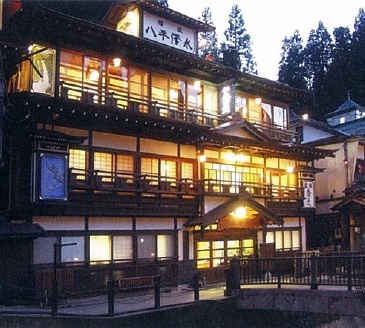
Unohana Gensen
Analysis UnverifiedThe name recalls Princess Unohana, said to have governed Nagai in the late Heian period. Drawn from about 1,000 m deep, the water balances sodium (411.7 mg), chloride (437.4 mg) and bicarbonate (361.3 mg), with 1,483 mg/kg of dissolved solids and a near-neutral pH of 7.8 that keeps it gentle on the skin.
The bar length shows how abundant each component is compared to thresholds that make it "distinctive" (therapeutic spring standards, beauty spring criteria, etc.).
A trace component with gentle antibacterial and anti-inflammatory action.
- Chloride (salt)437 mg/kg
- Feel
- Tastes salty; the warmth lasts after you get out.
- Said to
- Salt is said to form a film on the skin that keeps in heat and moisture. Bathing indications include cuts, poor circulation and dry skin.
- Note
- May sting cuts. Strong salty water can tire you—avoid long soaks.
- Bicarbonate (baking soda)361 mg/kg
- Feel
- Your skin feels smooth and silky.
- Said to
- Said to remove old skin cells and excess sebum. Bathing indications include cuts, poor circulation and dry skin.
- Note
- It can leave skin dry—moisturize after bathing.
- Source temperature42.1℃
- Feel
- The source is 42°C or hotter; the bath may be on the hot side.
- Said to
- Heat is said to boost circulation and warm the body.
- Note
- Older people and those with high blood pressure or heart conditions should avoid baths of 42°C or more. Keep soaks short.
Effects are general descriptions based on the Ministry of the Environment’s indications by spring type, not a guarantee.
Scores are calculated from mineral analysis data based on the Mineral Spring Analysis Guidelines (Ministry of Environment, Japan). They are unrelated to facility atmosphere or service quality.
▸Note
The temperature, pH and component values shown here are based on the hot spring analysis (source). Actual values in the bath may differ depending on heating, dilution, recycling and filtration. Please check current usage status at the facility.
At 42.1°C at the source, soak for 5-10 minutes, rest, then return. The chloride film keeps you warm long after, so drink water and dress before you cool down.
With 437.4 mg/kg of chloride forming a thin film on the skin, the water offers restorative warmth that lingers after bathing, while 361.3 mg/kg of bicarbonate and 35.4 mg/kg of metasilicic acid may help leave a silky skin feel.
The warming effect is strong, so avoid long soaks, drink water, and skip bathing when unwell, after alcohol or right after meals.
※ See the analysis data below for detailed contraindications
ANALYSIS DATAView all analysis fields ▼
Source Info
- Source name
- Unohana Gensen
- Spring type
- Sodium Chloride and Bicarbonate Hot Spring
- Source temperature
- 42.1℃
- pH
- 7.8
Analysis Document
- Analysis date
- 2015-06-26
- Analyst organization
- 日本環境科学株式会社
- Registration No.
- 温泉分析山形第2号
Cations
- Lithium ion Li⁺
- 0.20 mg/kg
- Sodium ion Na⁺
- 412 mg/kg
- Potassium ion K⁺
- 7.4 mg/kg
- Magnesium ion Mg²⁺
- 6.3 mg/kg
- Calcium ion Ca²⁺
- 60.1 mg/kg
- Aluminum ion Al³⁺
- 0.00 mg/kg
- Manganese ion Mn²⁺
- 0.10 mg/kg
- Iron(II) ion Fe²⁺
- 0.20 mg/kg
- Zinc ion Zn²⁺
- < 0.01 mg/kg
- Lead ion Pb²⁺
- < 0.01 mg/kg
- Copper ion Cu²⁺
- < 0.01 mg/kg
- Cadmium ion Cd²⁺
- < 0.01 mg/kg
- Total cations
- 486 mg/kg
Anions
- Fluoride ion F⁻
- 4.0 mg/kg
- Chloride ion Cl⁻
- 437 mg/kg
- Hydroxide ion OH⁻
- 0.00 mg/kg
- Hydrogen sulfide ion HS⁻
- 0.00 mg/kg
- Sulfate ion SO₄²⁻
- 149 mg/kg
- Bicarbonate ion HCO₃⁻
- 361 mg/kg
- Carbonate ion CO₃²⁻
- 1.6 mg/kg
- Bromide ion Br⁻
- 1.8 mg/kg
- Iodide ion I⁻
- 0.30 mg/kg
- Hydrogen sulfate HSO₄⁻
- 0.00 mg/kg
- Dihydrogen phosphate H₂PO₄⁻
- 0.00 mg/kg
- Hydrogen phosphate HPO₄²⁻
- 0.00 mg/kg
- Total anions
- 955 mg/kg
Undissociated Components
- Arsenious acid HAsO₂
- 0.00 mg/kg
- Metasilicic acid H₂SiO₃
- 35.4 mg/kg
- Metaboric acid HBO₂
- 7.1 mg/kg
- Total undissociated
- 42.5 mg/kg
Dissolved Gas
- Free carbon dioxide CO₂
- 10.6 mg/kg
- Free hydrogen sulfide H₂S
- < 0.1 mg/kg
- Total dissolved gas
- 10.6 mg/kg
Totals
- Total dissolved substances
- 1483 mg/kg
- Evaporation residue
- 1415 mg/kg
Usage
- Usage status
- Unknown
Indications & Contraindications
- Bathing indications
- Cuts and grazes, Peripheral circulatory failure, Poor circulation, Depression, Xeroderma
- General indications
- High blood pressure (mild), Rheumatoid arthritis, Autonomic instability, Insomnia, Chronic pain or stiffness in muscles and joints, Muscle stiffness due to motor paralysis, Gastrointestinal dysfunction
- Contraindications
- Acute illness (especially with fever), Active tuberculosis, Malignant tumors, Severe heart disease, Respiratory failure, Renal failure, Bleeding disorders, Severe anemia, Any actively progressing illness, Pregnancy (especially early and late stages)
Drinking
- Drinkability
- Not drinkable