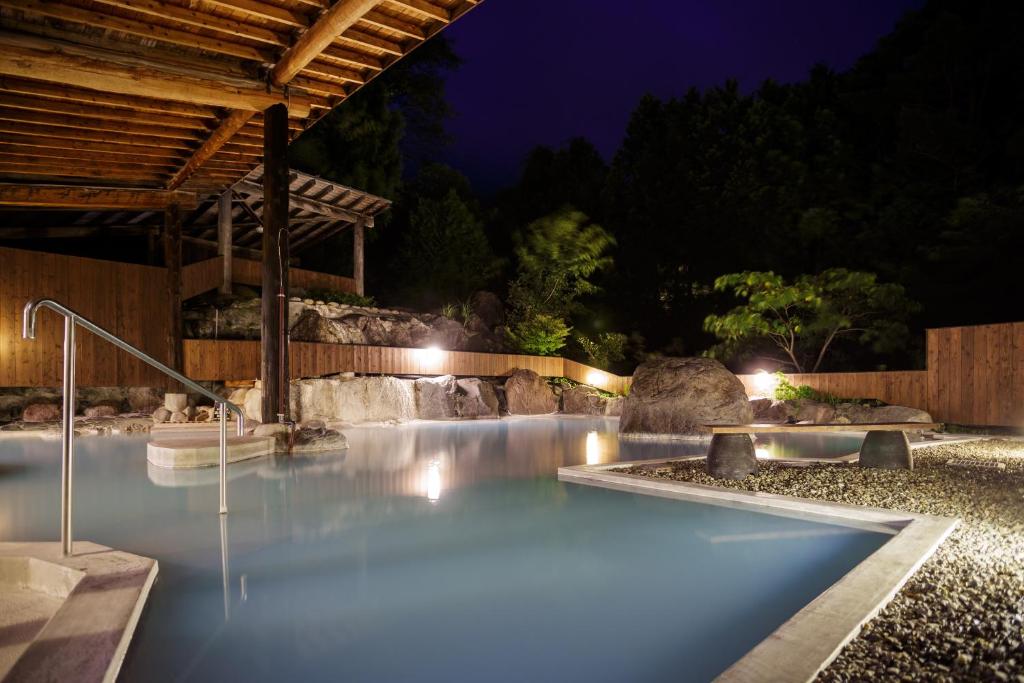
AMBER Yufuin
Analysis VerifiedThis is a newly drilled source in the Yufuin Onsen area, which boasts one of the largest outputs in Japan. Nestled at the foot of Mt. Yufu, this hot spring resort has long been cherished for therapeutic bathing. The AMBER Yufuin source features a high alkalinity of pH 8.9, combining the qualities of a bicarbonate spring that smooths the skin by removing old keratin, and a chloride spring that helps retain body heat. It is particularly characterized by its abundance of metasilicic acid, a natural moisturizing component.
The bar length shows how abundant each component is compared to thresholds that make it "distinctive" (therapeutic spring standards, beauty spring criteria, etc.).
A natural moisturizer also used in skincare lotions. Forms a thin veil on the skin to reduce moisture loss after bathing.
A trace component with gentle antibacterial and anti-inflammatory action.
- Chloride (salt)183 mg/kg
- Feel
- Tastes salty; the warmth lasts after you get out.
- Said to
- Salt is said to form a film on the skin that keeps in heat and moisture. Bathing indications include cuts, poor circulation and dry skin.
- Note
- May sting cuts. Strong salty water can tire you—avoid long soaks.
- Bicarbonate (baking soda)282 mg/kg
- Feel
- Your skin feels smooth and silky.
- Said to
- Said to remove old skin cells and excess sebum. Bathing indications include cuts, poor circulation and dry skin.
- Note
- It can leave skin dry—moisturize after bathing.
- Alkaline (pH)pH 8.9
- Feel
- Feels slippery and silky on the skin.
- Said to
- Said to remove old skin cells and excess sebum.
- Note
- Skin can dry out afterwards—moisturize after bathing.
- Metasilicic acid360 mg/kg
- Feel
- Your skin may feel smoother.
- Said to
- 50 mg/kg or more is said to mark a “skin-beautifying spring”; it is also used in skincare.
- Note
- The “skin-beautifying” label is a common rule of thumb, not a legal standard.
- Source temperature68.1℃
- Feel
- The source is 42°C or hotter; the bath may be on the hot side.
- Said to
- Heat is said to boost circulation and warm the body.
- Note
- Older people and those with high blood pressure or heart conditions should avoid baths of 42°C or more. Keep soaks short.
Effects are general descriptions based on the Ministry of the Environment’s indications by spring type, not a guarantee.
Scores are calculated from mineral analysis data based on the Mineral Spring Analysis Guidelines (Ministry of Environment, Japan). They are unrelated to facility atmosphere or service quality.
▸Note
The temperature, pH and component values shown here are based on the hot spring analysis (source). Actual values in the bath may differ depending on heating, dilution, recycling and filtration. Please check current usage status at the facility.
With a gentle, weakly alkaline pH of 8.9, this spring is kind to the skin. However, as the source temperature is a high 68.1°C, bathing should occur where water is added and the temperature is regulated. Rather than long soaks, repeated shorter dips ("bunkatsuyoku") are recommended. The chloride components will coat your skin, preventing chills after your bath.
Thanks to its pH 8.9 alkalinity and bicarbonate ions, this spring offers a "silky skin" effect, gently removing old keratin for a smooth feel. Furthermore, its rich metasilicic acid content of 360 mg/kg acts as a natural moisturizer. The high chloride ion content also creates a salt veil on the skin, providing "restorative warmth" that helps retain body heat after your bath.
The spring temperature is extremely high at 68.1°C, so be sure to bathe in a tub where water has been added and the temperature is properly adjusted. Those with general contraindications for onsen should avoid bathing.
※ See the analysis data below for detailed contraindications
ANALYSIS DATAView all analysis fields ▼
Source Info
- Source name
- AMBER Yufuin
- Spring type
- Sodium Chloride and Bicarbonate Hot Spring
- Old spring type name
- 含重曹食塩泉
- Source temperature
- 68.1℃
- pH
- 8.9
- Flow type
- 動力揚湯
- Osmotic pressure
- 低張性
Analysis Document
- Analysis date
- 2024-12-10
- Analyst organization
- 公益社団法人大分県薬剤師会
- Registration No.
- 大分県第3号
Cations
- Lithium ion Li⁺
- 0.30 mg/kg
- Sodium ion Na⁺
- 262 mg/kg
- Potassium ion K⁺
- 29.4 mg/kg
- Ammonium ion NH₄⁺
- 0.40 mg/kg
- Calcium ion Ca²⁺
- 1.7 mg/kg
- Lead ion Pb²⁺
- < 0.01 mg/kg
- Copper ion Cu²⁺
- < 0.05 mg/kg
- Cadmium ion Cd²⁺
- < 0.001 mg/kg
- Total cations
- 294 mg/kg
Anions
- Fluoride ion F⁻
- 0.40 mg/kg
- Chloride ion Cl⁻
- 183 mg/kg
- Hydroxide ion OH⁻
- 0.10 mg/kg
- Thiosulfate ion S₂O₃²⁻
- 0.30 mg/kg
- Sulfate ion SO₄²⁻
- 48.1 mg/kg
- Bicarbonate ion HCO₃⁻
- 282 mg/kg
- Carbonate ion CO₃²⁻
- 52.2 mg/kg
- Bromide ion Br⁻
- 0.50 mg/kg
- Hydrogen phosphate HPO₄²⁻
- 0.50 mg/kg
- Total anions
- 567 mg/kg
Undissociated Components
- Sulfuric acid H₂SO₄
- 0.00 mg/kg
- Phosphoric acid H₃PO₄
- 0.00 mg/kg
- Arsenious acid HAsO₂
- 0.20 mg/kg
- Metasilicic acid H₂SiO₃
- 360 mg/kg
- Metaboric acid HBO₂
- 9.5 mg/kg
- Total undissociated
- 370 mg/kg
Dissolved Gas
- Free carbon dioxide CO₂
- < 0.1 mg/kg
- Free hydrogen sulfide H₂S
- 0.00 mg/kg
- Total dissolved gas
- 0.00 mg/kg
Trace Components
- Radon Rn
- < 7.4 Bq/kg
Totals
- Total dissolved substances
- 1231 mg/kg
- Component total
- 1231 mg/kg
- Evaporation residue
- 944 mg/kg
Usage
- Usage status
- Unknown
Indications & Contraindications
- Bathing indications
- Cuts and grazes, Peripheral circulatory failure, Poor circulation, Depression, Xeroderma
- General indications
- High blood pressure (mild), Rheumatoid arthritis, Autonomic instability, Insomnia, Chronic pain or stiffness in muscles and joints, Muscle stiffness due to motor paralysis, Gastrointestinal dysfunction
- Contraindications
- Acute illness (especially with fever), Active tuberculosis, Malignant tumors, Severe heart disease, Respiratory failure, Renal failure, Bleeding disorders, Severe anemia, Any actively progressing illness, Pregnancy (especially early and late stages)
Drinking
- Drinkability
- Not drinkable