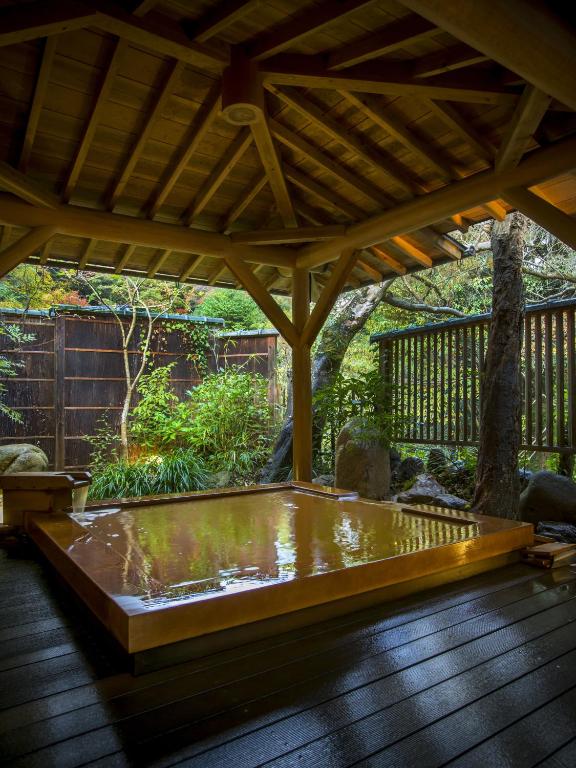
Uwanari Gensen
Analysis VerifiedAmong Arima's many "Kinsen" gold springs, the Uwanari Gensen possesses a uniquely dramatic legend. Its name, meaning "Jealousy Spring," originates from a tale where the water would boil with envy whenever a beautiful woman passed by. The current source was drilled behind the original legendary well after it ran dry, and its waters are now distributed throughout the Arima hot spring district via the Gosho source and others. This hypertonic spring, extremely rich in iron and salt, warms the body to its core, with a restorative warmth that lingers long after bathing. It is the perfect bath for a day when you wish to soothe both body and soul while reflecting on history and legend.
The bar length shows how abundant each component is compared to thresholds that make it "distinctive" (therapeutic spring standards, beauty spring criteria, etc.).
Undissociated boric acid with antibacterial action that keeps the skin surface clean.
Salinity comparable to seawater. The salt film traps heat for outstanding warmth ("hot bath spring").
Salt forms a thin film on the skin, retaining heat after bathing. Helps with poor circulation.
An iron-rich spring whose water turns yellow-brown to red-brown when exposed to air. Strong heat retention.
- Iron67 mg/kg
- Feel
- Turns reddish-brown in the air, with a rusty-iron smell.
- Said to
- Said to warm the body; where drinking is permitted, said to help iron-deficiency anemia.
- Note
- May stain white towels and swimwear.
- Chloride (salt)21980 mg/kg
- Feel
- Tastes salty; the warmth lasts after you get out.
- Said to
- Salt is said to form a film on the skin that keeps in heat and moisture. Bathing indications include cuts, poor circulation and dry skin.
- Note
- May sting cuts. Strong salty water can tire you—avoid long soaks.
- Metasilicic acid160 mg/kg
- Feel
- Your skin may feel smoother.
- Said to
- 50 mg/kg or more is said to mark a “skin-beautifying spring”; it is also used in skincare.
- Note
- The “skin-beautifying” label is a common rule of thumb, not a legal standard.
- Source temperature100.5℃
- Feel
- The source is 42°C or hotter; the bath may be on the hot side.
- Said to
- Heat is said to boost circulation and warm the body.
- Note
- Older people and those with high blood pressure or heart conditions should avoid baths of 42°C or more. Keep soaks short.
Effects are general descriptions based on the Ministry of the Environment’s indications by spring type, not a guarantee.
Scores are calculated from mineral analysis data based on the Mineral Spring Analysis Guidelines (Ministry of Environment, Japan). They are unrelated to facility atmosphere or service quality.
▸Note
The temperature, pH and component values shown here are based on the hot spring analysis (source). Actual values in the bath may differ depending on heating, dilution, recycling and filtration. Please check current usage status at the facility.
This is an extremely hot spring over 100°C with high salt concentration. Avoid long soaks; instead, practice "bunkatsu-yu" (split bathing) with short, repeated dips. The salt helps retain moisture, but those with sensitive skin may want to rinse off lightly with a shower afterward.
With a total dissolved solids count of 37.6 g/kg, this hypertonic spring is a prime example of balneotherapy. Its abundant chloride ions (21980 mg/kg) form a thin veil on the skin, providing exceptional restorative warmth and preventing post-bath chills. It's ideal for those seeking deep warmth and may support the relief of chronic pain.
This is a hypertonic spring extremely rich in salt and iron. Due to its very high temperature, individuals with high blood pressure or heart conditions should bathe with caution. Avoid prolonged soaking and stay hydrated.
※ See the analysis data below for detailed contraindications
ANALYSIS DATAView all analysis fields ▼
Source Info
- Source name
- Uwanari Gensen
- Spring type
- Iron-containing Sodium Chloride strong saline Hot Spring (Hypertonic Neutral high-temperature hot spring)
- Source temperature
- 100.5℃
- pH
- 6.7
- Flow rate
- 120 L/min
- Flow type
- 掘削・自噴
- Osmotic pressure
- 高張性
Analysis Document
- Analysis date
- 2019-09-24
- Analyst organization
- 公益財団法人 中央温泉研究所
- Registration No.
- 14健地衛第1号
Cations
- Sodium ion Na⁺
- 10840 mg/kg
- Potassium ion K⁺
- 2045 mg/kg
- Ammonium ion NH₄⁺
- 4.0 mg/kg
- Magnesium ion Mg²⁺
- 13.8 mg/kg
- Calcium ion Ca²⁺
- 1825 mg/kg
- Aluminum ion Al³⁺
- 0.00 mg/kg
- Manganese ion Mn²⁺
- 17.1 mg/kg
- Iron(II) ion Fe²⁺
- 67.0 mg/kg
- Total cations
- 14810 mg/kg
Anions
- Fluoride ion F⁻
- 0.30 mg/kg
- Chloride ion Cl⁻
- 21980 mg/kg
- Hydrogen sulfide ion HS⁻
- 0.10 mg/kg
- Thiosulfate ion S₂O₃²⁻
- 0.00 mg/kg
- Sulfate ion SO₄²⁻
- 29.6 mg/kg
- Bicarbonate ion HCO₃⁻
- 298 mg/kg
- Carbonate ion CO₃²⁻
- 0.00 mg/kg
- Bromide ion Br⁻
- 38.7 mg/kg
- Iodide ion I⁻
- 5.1 mg/kg
- Total anions
- 22350 mg/kg
Undissociated Components
- Metasilicic acid H₂SiO₃
- 160 mg/kg
- Metaboric acid HBO₂
- 272 mg/kg
- Total undissociated
- 432 mg/kg
Dissolved Gas
- Free carbon dioxide CO₂
- 136 mg/kg
- Free hydrogen sulfide H₂S
- 0.20 mg/kg
- Total dissolved gas
- 137 mg/kg
Totals
- Total dissolved substances
- 37600 mg/kg
- Component total
- 37730 mg/kg
- Evaporation residue
- 37960 mg/kg
Usage
- Heating
- No
- Dilution
- No
- Recycle / Filter
- No
- Additives
- No
- Disinfection
- No
Indications & Contraindications
- Bathing indications
- Cuts and grazes, Peripheral circulatory failure, Poor circulation, Depression, Xeroderma
- General indications
- High blood pressure (mild), Rheumatoid arthritis, Autonomic instability, Insomnia, Chronic pain or stiffness in muscles and joints, Muscle stiffness due to motor paralysis, Gastrointestinal dysfunction
- Contraindications
- Acute illness (especially with fever), Active tuberculosis, Malignant tumors, Severe heart disease, Respiratory failure, Renal failure, Bleeding disorders, Severe anemia, Any actively progressing illness, Pregnancy (especially early and late stages)
Drinking
- Drinkability
- Not drinkable