Hirokawara Gensen
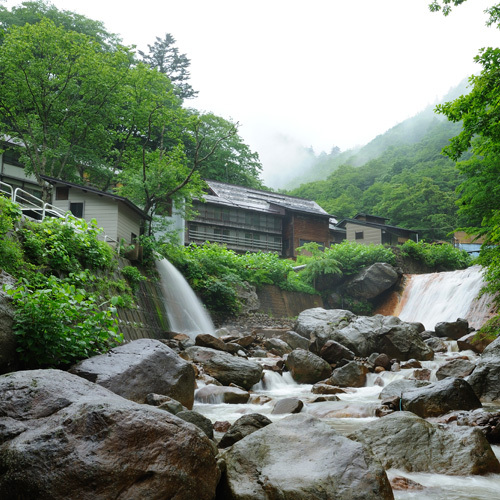
Analysis UnverifiedSaid to have been found by gold prospectors some four centuries ago, this lukewarm source rises beside a mountain stream deep in the Iide range. Bath huts stood here by the late Meiji era, when visitors walked hours along forest trails to reach it. Carbon dioxide drives the water up from a drilled well, periodically sending a column of spring water into the air. Its tea-brown water tastes bitter and faintly of iron, rewarding those who seek remote, unhurried soaks.
The bar length shows how abundant each component is compared to thresholds that make it "distinctive" (therapeutic spring standards, beauty spring criteria, etc.).
A "beauty spring" that gently emulsifies dead skin cells, leaving skin smooth after bathing.
Absorbed through the skin to gently promote peripheral circulation.
A natural moisturizer also used in skincare lotions. Forms a thin veil on the skin to reduce moisture loss after bathing.
Scores are calculated from mineral analysis data based on the Mineral Spring Analysis Guidelines (Ministry of Environment, Japan). They are unrelated to facility atmosphere or service quality.
▸Note
The temperature, pH and component values shown here are based on the hot spring analysis (source). Actual values in the bath may differ depending on heating, dilution, recycling and filtration. Please check current usage status at the facility.
At 33.1°C the source is cooler than body temperature, so linger longer to relax deeply, then dry off and warm up promptly afterwards. Its iron content may stain white towels.
With 1562 mg/kg of bicarbonate, this neutral, lukewarm water is traditionally associated with silky skin, while 508.9 mg/kg of chloride leaves skin feeling moist. Free carbon dioxide at 636.6 mg/kg adds a refreshing touch that may support rejuvenation in the quiet mountains.
Even lukewarm soaks can chill the body if overly long, so keep warm afterwards; in summer, horseflies and other insects can be numerous in this remote mountain setting.
※ See the analysis data below for detailed contraindications
ANALYSIS DATAView all analysis fields ▼
Source Info
- Source name
- Hirokawara Gensen
- Spring type
- Sodium-Calcium Bicarbonate and Chloride Hot Spring
- Source temperature
- 33.1℃
- pH
- 6.8
- Flow type
- 掘削自噴
- Osmotic pressure
- 低張性
Analysis Document
- Analysis date
- 2009-12-25
- Analyst organization
- 株式会社丹野
- Registration No.
- 温泉分析山形第3号
Cations
- Lithium ion Li⁺
- 1.4 mg/kg
- Sodium ion Na⁺
- 454 mg/kg
- Potassium ion K⁺
- 50.7 mg/kg
- Magnesium ion Mg²⁺
- 48.1 mg/kg
- Calcium ion Ca²⁺
- 295 mg/kg
- Manganese ion Mn²⁺
- 4.1 mg/kg
- Iron(II) ion Fe²⁺
- 6.1 mg/kg
- Total cations
- 0.86 mg/kg
Anions
- Fluoride ion F⁻
- 0.40 mg/kg
- Chloride ion Cl⁻
- 509 mg/kg
- Sulfate ion SO₄²⁻
- 7.7 mg/kg
- Bicarbonate ion HCO₃⁻
- 1562 mg/kg
- Carbonate ion CO₃²⁻
- 0.60 mg/kg
- Bromide ion Br⁻
- 2.0 mg/kg
- Iodide ion I⁻
- 0.20 mg/kg
- Total anions
- 2.1 mg/kg
Undissociated Components
- Metasilicic acid H₂SiO₃
- 120 mg/kg
- Metaboric acid HBO₂
- 2.0 mg/kg
- Total undissociated
- 0.12 mg/kg
Dissolved Gas
- Free carbon dioxide CO₂
- 637 mg/kg
- Total dissolved gas
- 0.64 mg/kg
Totals
- Total dissolved substances
- 3.1 mg/kg
- Component total
- 3.7 mg/kg
- Evaporation residue
- 2.4 mg/kg
Usage
- Heating
- Yes
- Dilution
- No
- Recycle / Filter
- No
- Additives
- No
- Disinfection
- No
Indications & Contraindications
- Bathing indications
- Cuts and grazes, Peripheral circulatory failure, Poor circulation, Xeroderma, Depression
- General indications
- High blood pressure (mild), Rheumatoid arthritis, Autonomic instability, Insomnia, Chronic pain or stiffness in muscles and joints, Muscle stiffness due to motor paralysis, Gastrointestinal dysfunction
- Contraindications
- Acute illness (especially with fever), Active tuberculosis, Malignant tumors, Severe heart disease, Respiratory failure, Renal failure, Bleeding disorders, Severe anemia, Any actively progressing illness, Pregnancy (especially early and late stages)
Drinking
- Drinkability
- Not drinkable