Ryusenkaku Private Spring
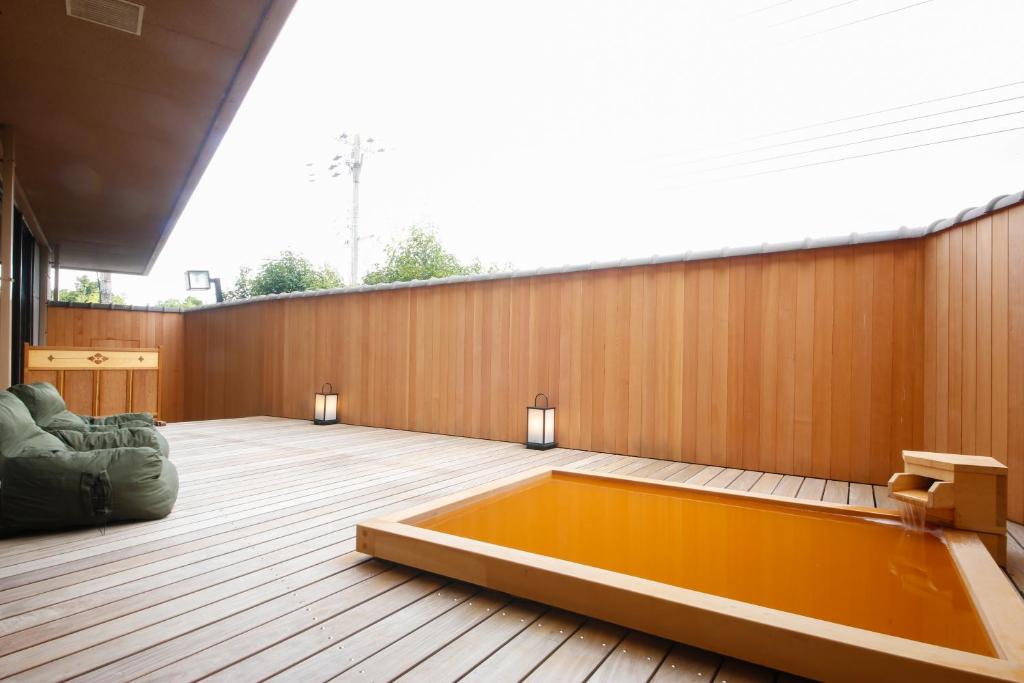
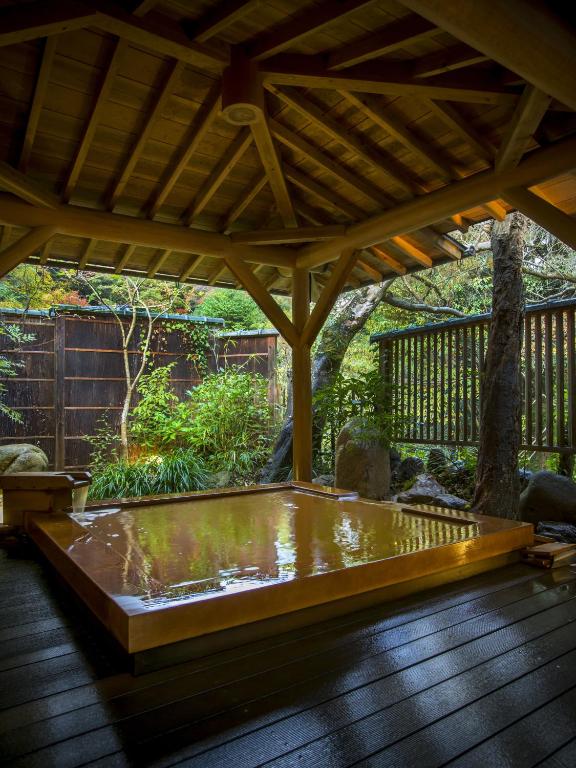
Analysis UnverifiedThe Ryusenkaku Private Spring is pumped from a drilled well in Utsugidani, on the hillside of Arima Onsen, one of Japan's three oldest spa towns. It rises a pale yellowish brown, then its abundant iron oxidizes in the air and steeps the bath in Arima's signature rusty red. A brine about half as salty as seawater wraps the skin, and the warmth lingers long after bathing, suited to anyone wanting slow, deep warmth on chilly days.
The bar length shows how abundant each component is compared to thresholds that make it "distinctive" (therapeutic spring standards, beauty spring criteria, etc.).
Undissociated boric acid with antibacterial action that keeps the skin surface clean.
A rare radioactive spring where trace radiation absorbed via inhalation and skin is expected to stimulate cells (the "hormesis effect").
Salinity comparable to seawater. The salt film traps heat for outstanding warmth ("hot bath spring").
An iron-rich spring whose water turns yellow-brown to red-brown when exposed to air. Strong heat retention.
Salt forms a thin film on the skin, retaining heat after bathing. Helps with poor circulation.
Scores are calculated from mineral analysis data based on the Mineral Spring Analysis Guidelines (Ministry of Environment, Japan). They are unrelated to facility atmosphere or service quality.
▸Note
The temperature, pH and component values shown here are based on the hot spring analysis (source). Actual values in the bath may differ depending on heating, dilution, recycling and filtration. Please check current usage status at the facility.
This dense hypertonic brine (17.66 g/kg) is best taken in short dips of about five minutes with rests between. Iron can stain white towels, so bring a dark one, and rinse lightly with fresh water afterward.
With 9,374.6 mg/kg of chloride, the brine leaves a fine salt film that offers restorative warmth long after bathing. Carrying 57.9 mg/kg of iron, this kinsen is traditionally associated with balneotherapy for chills and may support relieving pain in stiff shoulders and lower back.
As a strong hypertonic chloride spring it can tire the body quickly; avoid long soaks, and those with sensitive skin should rinse with fresh water afterward.
※ See the analysis data below for detailed contraindications
ANALYSIS DATAView all analysis fields ▼
Source Info
- Source name
- Ryusenkaku Private Spring
- Spring type
- Iron(II,III)-containing Sodium Chloride Hot Spring (Hypertonic Neutral low-temperature hot spring)
- Source temperature
- 33.3℃
- pH
- 6
- Flow rate
- 59 L/min
- Flow type
- 掘削・ポンプ揚湯
- Osmotic pressure
- 高張性
Analysis Document
- Analysis date
- 2016-04-27
- Analyst organization
- 公益財団法人ひょうご環境創造協会
- Registration No.
- 薬第07E-0001号
Cations
- Lithium ion Li⁺
- 13.7 mg/kg
- Sodium ion Na⁺
- 4973 mg/kg
- Potassium ion K⁺
- 318 mg/kg
- Ammonium ion NH₄⁺
- 2.0 mg/kg
- Magnesium ion Mg²⁺
- 56.4 mg/kg
- Calcium ion Ca²⁺
- 974 mg/kg
- Manganese ion Mn²⁺
- 1.7 mg/kg
- Iron(II) ion Fe²⁺
- 57.9 mg/kg
- Zinc ion Zn²⁺
- 0.70 mg/kg
- Lead ion Pb²⁺
- 0.01 mg/kg
- Strontium ion Sr²⁺
- 19.7 mg/kg
- Barium ion Ba²⁺
- 14.2 mg/kg
- Copper ion Cu²⁺
- < 0.01 mg/kg
- Cadmium ion Cd²⁺
- < 0.0003 mg/kg
- Total cations
- 6.4 mg/kg
Anions
- Fluoride ion F⁻
- 0.30 mg/kg
- Chloride ion Cl⁻
- 9375 mg/kg
- Sulfate ion SO₄²⁻
- 20.7 mg/kg
- Bicarbonate ion HCO₃⁻
- 706 mg/kg
- Bromide ion Br⁻
- 20.6 mg/kg
- Total anions
- 10.1 mg/kg
Undissociated Components
- Arsenious acid HAsO₂
- 0.30 mg/kg
- Metasilicic acid H₂SiO₃
- 89.2 mg/kg
- Metaboric acid HBO₂
- 89.2 mg/kg
- Total undissociated
- 0.18 mg/kg
Dissolved Gas
- Free carbon dioxide CO₂
- 926 mg/kg
- Total dissolved gas
- 0.93 mg/kg
Trace Components
- Radon Rn
- 63 Bq/kg
Totals
- Total dissolved substances
- 16.7 mg/kg
- Component total
- 17.7 mg/kg
- Evaporation residue
- 17.2 mg/kg
Usage
- Usage status
- Unknown
Indications & Contraindications
- Bathing indications
- Cuts and grazes, Peripheral circulatory failure, Poor circulation, Depression, Xeroderma
- General indications
- High blood pressure (mild), Rheumatoid arthritis, Autonomic instability, Insomnia, Chronic pain or stiffness in muscles and joints, Muscle stiffness due to motor paralysis, Gastrointestinal dysfunction
- Contraindications
- Acute illness (especially with fever), Active tuberculosis, Malignant tumors, Severe heart disease, Respiratory failure, Renal failure, Bleeding disorders, Severe anemia, Any actively progressing illness, Pregnancy (especially early and late stages)
Drinking
- Drinkability
- Not drinkable