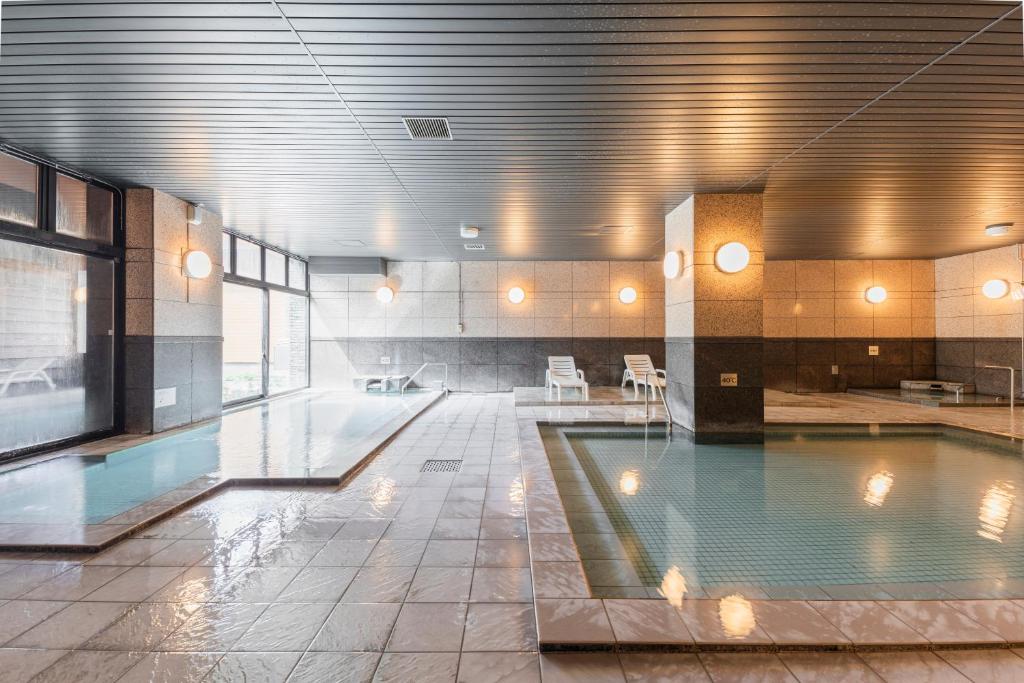
Horoka Onsen Source B
Analysis UnverifiedHoroka Onsen lies in the mountains east of the Daisetsuzan range, north of Lake Nukabira, and is said to have been found in 1928 during pulpwood logging. Springs A to F dot the valley and hillside, and Source B has long been nicknamed the 'カルシューム泉' bath. In fact it is a neutral sodium chloride-bicarbonate water holding 236.6 mg/kg of free carbon dioxide, smooth on the skin with a gentle salty taste. It suits travellers who want a quiet, unhurried soak deep in the forest.
The bar length shows how abundant each component is compared to thresholds that make it "distinctive" (therapeutic spring standards, beauty spring criteria, etc.).
Undissociated boric acid with antibacterial action that keeps the skin surface clean.
A "beauty spring" that gently emulsifies dead skin cells, leaving skin smooth after bathing.
A natural moisturizer also used in skincare lotions. Forms a thin veil on the skin to reduce moisture loss after bathing.
Absorbed through the skin to gently promote peripheral circulation.
Scores are calculated from mineral analysis data based on the Mineral Spring Analysis Guidelines (Ministry of Environment, Japan). They are unrelated to facility atmosphere or service quality.
▸Note
The temperature, pH and component values shown here are based on the hot spring analysis (source). Actual values in the bath may differ depending on heating, dilution, recycling and filtration. Please check current usage status at the facility.
The source emerges at 63.3°C and bath temperatures shift with the weather, so pour water over your limbs first to check, and take shorter repeated soaks if it feels hot. The neutral water is gentle on skin; simply pat dry afterward.
With 944.2 mg/kg of chloride, a thin salt film is said to slow sweat evaporation for lingering restorative warmth, while 1,025 mg/kg of bicarbonate may support the silky skin feel bathers notice.
The source is hot, so avoid long soaks if the bath feels too warm. Those in acute illness or with serious heart or respiratory conditions should refrain or consult a doctor; avoid bathing after drinking or eating.
※ See the analysis data below for detailed contraindications
ANALYSIS DATAView all analysis fields ▼
Source Info
- Source name
- Horoka Onsen Source B
- Spring type
- Sodium Chloride and Bicarbonate Hot Spring
- Source temperature
- 63.3℃
- pH
- 7
- Flow type
- 自然湧出
- Osmotic pressure
- 低張性
Analysis Document
- Analysis date
- 2022-12-20
- Analyst organization
- 株式会社第一岸本臨床検査センター
- Registration No.
- 北海道第12号
Cations
- Lithium ion Li⁺
- 0.40 mg/kg
- Sodium ion Na⁺
- 850 mg/kg
- Potassium ion K⁺
- 83.0 mg/kg
- Ammonium ion NH₄⁺
- 5.8 mg/kg
- Magnesium ion Mg²⁺
- 8.3 mg/kg
- Calcium ion Ca²⁺
- 112 mg/kg
- Aluminum ion Al³⁺
- not detected
- Manganese ion Mn²⁺
- 1.0 mg/kg
- Zinc ion Zn²⁺
- not detected
- Lead ion Pb²⁺
- not detected
- Copper ion Cu²⁺
- not detected
- Cadmium ion Cd²⁺
- not detected
- Total cations
- 1.1 mg/kg
Anions
- Fluoride ion F⁻
- 0.40 mg/kg
- Chloride ion Cl⁻
- 944 mg/kg
- Hydrogen sulfide ion HS⁻
- 0.20 mg/kg
- Thiosulfate ion S₂O₃²⁻
- 0.00 mg/kg
- Sulfate ion SO₄²⁻
- 2.6 mg/kg
- Bicarbonate ion HCO₃⁻
- 1025 mg/kg
- Carbonate ion CO₃²⁻
- 0.80 mg/kg
- Bromide ion Br⁻
- 3.1 mg/kg
- Iodide ion I⁻
- 1.6 mg/kg
- Total anions
- 2.0 mg/kg
Undissociated Components
- Metasilicic acid H₂SiO₃
- 133 mg/kg
- Metaboric acid HBO₂
- 149 mg/kg
- Total undissociated
- 0.28 mg/kg
Dissolved Gas
- Free carbon dioxide CO₂
- 237 mg/kg
- Free hydrogen sulfide H₂S
- 0.20 mg/kg
- Total dissolved gas
- 0.24 mg/kg
Totals
- Total dissolved substances
- 3.3 mg/kg
- Component total
- 3.6 mg/kg
- Evaporation residue
- 2.8 mg/kg
Usage
- Usage status
- Unknown
Indications & Contraindications
- Bathing indications
- Cuts and grazes, Peripheral circulatory failure, Poor circulation, Depression, Xeroderma
- General indications
- High blood pressure (mild), Rheumatoid arthritis, Autonomic instability, Insomnia, Chronic pain or stiffness in muscles and joints, Muscle stiffness due to motor paralysis, Gastrointestinal dysfunction
- Contraindications
- Acute illness (especially with fever), Active tuberculosis, Malignant tumors, Severe heart disease, Respiratory failure, Renal failure, Bleeding disorders, Severe anemia, Any actively progressing illness, Pregnancy (especially early and late stages)
Drinking
- Drinkability
- Not drinkable